
4849 Farm to Market Road 1488, Suite 800, Magnolia, TX 77354

Restore Your Smile with Bone Grafting
Periodontal disease is the primary cause of bone loss in the oral cavity, but factors such as ill-fitting dentures and facial trauma can also contribute. Bone grafting is a highly effective procedure designed to replace lost bone tissue and stimulate natural bone regeneration. This versatile and reliable treatment addresses a variety of dental concerns.
Bone grafting may be necessary to create a solid foundation for dental implant placement, slow the progression of gum disease, or improve the overall appearance of your smile. To learn more about bone grafting in Magnolia, TX, contact at 281.971.2120.
There are several types of dental bone grafts. The following are the most common:
- Autogenous Bone Graft: Bone is harvested from the patient’s own body, commonly from the pelvis, chin, or jaw. For larger grafts, the hip or shin bone may be used.
- Allograft: Uses synthetic bone or cadaver bone from a bone bank for the grafting procedure.
- Xenograft: Bovine (cow) bone is implanted, offering a safe and effective option without the need for a secondary donor site.
“Friendly staff and great service from the dentist. Everyone [makes] sure that you [are] doing well and in no pain. Get to pick what movie that you’d enjoy watching & listening to while they do their procedures on you and still [they make] you feel good through your whole visit!”
Reasons for Bone Grafting
There are a wide variety of reasons why bone grafting may be the best option for restoring the jaw bone.
- Dental Implants: Bone grafting strengthens the jawbone for secure implant placement when bone quality or quantity is insufficient.
- Sinus Lift: Elevates the sinus membrane and adds bone to the sinus floor for stable implant placement.
- Ridge Augmentation: Fills ridges in the jawbone caused by trauma, defects, or periodontal disease, creating a uniform shape.
- Nerve Repositioning: Moves the inferior alveolar nerve to enable implant placement while preserving sensation in the lower lip and chin.
What Does Bone Grafting Treatment Involve?
Bone grafting is a straightforward procedure typically performed under local anesthesia. For extensive grafts, general anesthesia may be necessary.
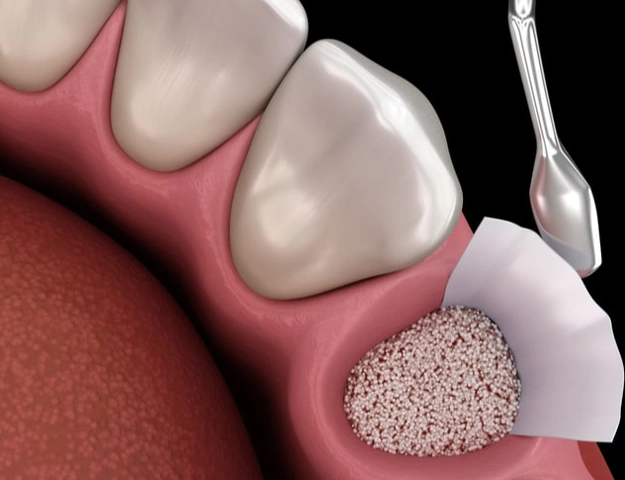
The grafting material is harvested or prepared, and a small incision is made in the gum tissue to expose the bone. The graft material is then placed at the affected site.
Bone regeneration may be enhanced by:
- Gum/Bone Tissue Regeneration: A thin membrane is placed under the gum line over the graft material, creating space for healthy tissue to grow. This barrier ensures bone cells, not gum tissue, populate the area for natural growth.
- Tissue-Stimulating Proteins: Products like Emdogain, containing enamel matrix proteins, are applied to the site to aid periodontal attachment and rebuild lost support in affected areas.
- Platelet-Rich Growth Factors (PRGF): PRGF stimulates bone growth and forms a dense graft more quickly by creating a high-platelet blood clot at the wound site.